
Are you a future AI leader or laggard? Master the 6 success tenets
- Natasha Sodhi
- 21 hours ago
- 4 min read

The AI winners race

“One of my predictions is the 2030s will see a faster rate of demise of Fortune 500 companies than we've ever seen.”
~ Vinod Khosla
Are you positioning yourself outright as an AI leader or laggard, or will you become an “average” corporation of the future based on your decisions today? Even being average will not come easy in the AI world, as the win returns will be multiples higher for leaders than for the followers. Per a 2025 BCG study1, AI leaders currently outpace laggards with double the revenue growth and 40% more cost savings.
In the future, the industry sector leaders and the technology giants will end up in a three legged race, with co-dependence on the speed of innovation. This innovation will go beyond today’s LLMs (large language models), and will require more front to back model integration across varying modalities. The key will be to make the “right” thoughtful investments today, in your sector, have the right foundational platform(s), and put your innovator hat on to iteratively design and position the future moonshots as the markets evolve.
Tomorrow’s AI leaders should not visualize the blue sky roadmap with today’s AI models, but should reimagine it from the AGI/ ASI acceleration vantage point, to re envision the next 5-10 years.
Your six P-armed AI rocket ship - Key considerations

Success in the AI race requires a strong foundation across 6 key tenets: Purpose, Products, Partnerships, People, Processes and Platforms. Your organization needs to carefully think through the key considerations in these areas, to efficiently align your investments for future ROI.
1. Purpose - Have you envisioned how your organization’s purpose will evolve across next 5-10 years, as AI accelerates?
2. Products & Services - Is your corporation truly adopting AI in the most optimal and innovative way to lead and win, by mapping your strategic roadmap to the future AI acceleration curve, instead of mapping it to today’s AI options?
3. Partnerships - Which industry-sector & technology partnerships will be critical to strategically implement your future AI vision and roadmap at a rapid pace? Do we need to rethink the line between competition and partnership in the AI context, to integrate products & services offerings?
4. People - What is the pathway to rightly grow your people in the future AI world, as AI is proceeding on the smarting up route, and humans become “users” of AI, who do not need to keep pushing on expanding intelligence frontiers in the traditional way?
5. Processes - As AI agents take over, which processes do you need to reimagine, and which processes can you just automate, eventually reducing and repurposing your workforce? Can this replace or change your ERP and CRM journey(s) leading to bottomline savings with Board level significance, if you plan it right?
6. Platforms - Are your data and technology platforms fragmented across multiple legacy systems across your company and its prior acquisitions? Do you need to get ahead to smoothly implement AI models, and redesign existing platforms to adopt a more modular architecture while replanning your organization data plan? Have you aligned your roadmap with the upcoming AI model evolution?
Guiding Principles for your AI rocket ship’s success

As you thoughtfully answer the questions above with your senior leaders, to envision the promising AI foundation for your organization, it will be important to adopt guiding principles across each of the 6 dimensions.
These will serve as a strong foundation for your organization’s employees to align on a common AI way of working, and build out the architecture to support your vision.
AI Execution - Early Results in 12+ Weeks with Long-term View
Regardless of how agile spirited or traditional your organization may be, there is always a path for you to start seeing preliminary results in as little as 12 weeks. The key is to be constantly agile, with clear blue sky strategic AI thinking, which can be used as a starting baseline to test and iterate the six foundational AI tenets. The goal is not to achieve perfect outcome(s), but to learn quickly from both successes and failures. In the new age AI world, speed will be a much bigger currency than it ever was in the Digital transformation decade, with closer neck to neck plays.
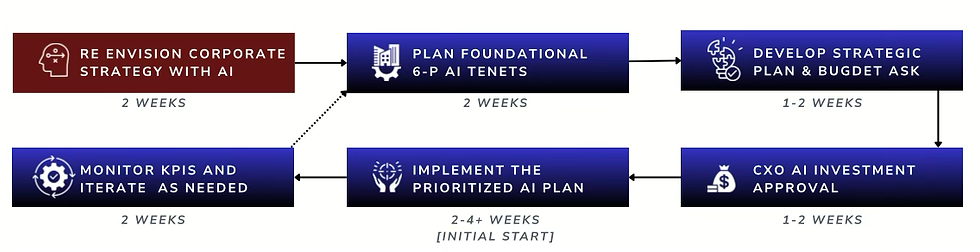
Remember, 12 weeks is just the onset of the delivery of results, but given the rapid pace of AI evolution, you need to keep your long-term mindset in the regatta view. The winds will sometimes blow uncertainly, and you need to be agile to re-tack your organization’s sailboat along the path.
So What & Next Steps?
As your organization strategically embarks on its AI journey, you need to shift focus from the “trend of the day” implementing the “one-off” hot use cases. The innovation pockets and organization wide engagement are both required, but the C suite needs to align on the appropriate structure to centralize and/or federate the AI movement, based on the sector and company specific needs. Additionally, senior leadership needs to ensure that your organization’s employees are anchored to a central well defined AI led vision, purpose and strategy, to innovate in a converging direction.
The upcoming series of articles will deep dive on each of these 6 tenets, to lay out the blueprint for more detailed discussions and engagement.
Do leave your comments and thoughts, on how you view the AI journey for your organization, and the wins and uncertainties along the way to achieve real winning returns. This will spark exciting discussions for us to stay connected, and collectively win!
About the Author
Natasha Sodhi is the Chief Advisor at IvyAgents.AI . She served as a Director at PwC, leading their flagship AI Strategy offering, as well as the Digital Strategy & Transformation offering. Prior to that, she developed AI and people thought leadership, while leading Digital, AI and Data engagements, at BCG in the US. Previously, she led a $60B digital product P&L for a financial services leader, actively employing AL, ML and data advantages to win in the market. She started her journey as a tech entrepreneur, leading development of innovative wireless communications products centered around data and signal analysis. She was also awarded the Anne Harding fellowship from the Wharton School, in addition to research and entrepreneurship grants from European Space Agency and Indian Department of Scientific & Industrial Research.


Comments